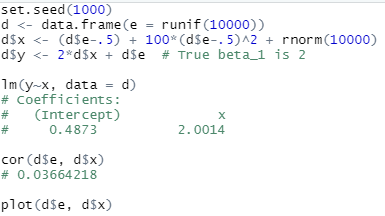
This morning I saw an interesting tweet by Nick HK, who ran a simulation to convince himself of the fact that OLS consistency only requires Corr(X, ε) = 0 but not independence:
I still find it hard to believe that OLS consistency only relies on X being uncorrelated with ε, not independent of ε, and I occasionally run a simulation to re-convince myself.
I had no doubt about the conclusion, primarily because I had kindly returned most of the things I learned in the linear models class to the instructor after I passed the exams more than a decade ago (sorry, Dr. Nettleton!).
What I found not quite convincing was that Nick only ran the simulation once. A
single estimate of $\beta$ is not convincing to me to show that the OLS
estimator is consistent, even if its value (2.0014) is fairly close to the true
parameter (2).
BTW, this is off-topic, but usually I’m slightly less convinced about simulation results obtained from a fixed random seed. Fixing the seed is common practice for reproducibility, but reproducibility should be independent with the seed (for random simulations, I think reproducibility “in the ballpark” is more useful than “digit-to-digit” reproducibility).
A silly counterexample
If we could conclude consistency from an estimate in one simulation, we would
conclude the same thing by estimating $\beta$ from the equation
y = 2 * x + e, where e = 0.0014 * x, which means ε and X are perfectly
correlated:
x = runif(10000)
e = .0014 * x
y = 2 * x + e  # i.e., y = 2.0014x
lm(y ~ x)
Apparently it would not be sensible, even if we get the same estimated value (2.0014), to conclude that consistency still exists when Corr(X, ε) = 1.
N needs to increase to illustrate consistency
If I remember correctly, consistency means convergence (of $\hat{\beta}$ to
$\beta$) in probability, as the sample size N increases to infinity. That
means we need to examine the behavior of the estimator as N increases. Below is
a function to estimate the slope of the simple linear regression, with a slight
modification (changing lm() to lm.fit() for speed) based on Nick’s R code:
beta_est = function(N = 10) {
  e = runif(N)
  x = (e - .5) + 100 * (e - .5)^2 + rnorm(N)
  y = 2 * x + e
  res = lm.fit(cbind(1, x), y)
  res$coefficients[2]  # the slope
}
Next we estimate the coefficient 30 times for different sample sizes N = 10, 210, 410, ….
Ns = rep(seq(10, 15000, 200), each = 30)
bs = numeric(length(Ns))
for (i in seq_along(Ns)) {
  bs[i] = beta_est(Ns[i])
}
Last we draw a scatterplot to illustrate how the estimate “converges” to its true value. Note that is is only an illustration of the overall trend. Of course, an illustration is not a proof.
par(mar = c(4, 4.5, .2, .2))
plot(
  Ns, bs, cex = .6, col = 'gray',
  xlab = 'N', ylab = expression(hat(beta))
)
abline(h = 2, lwd = 2)
points(10000, 2.0014, col = 'red', cex = 2, lwd = 2)
arrows(10000, 2.0014, 8000, 1.99)
text(8000, 1.987, 'Estimate from the simulation
 mentioned in the tweet')
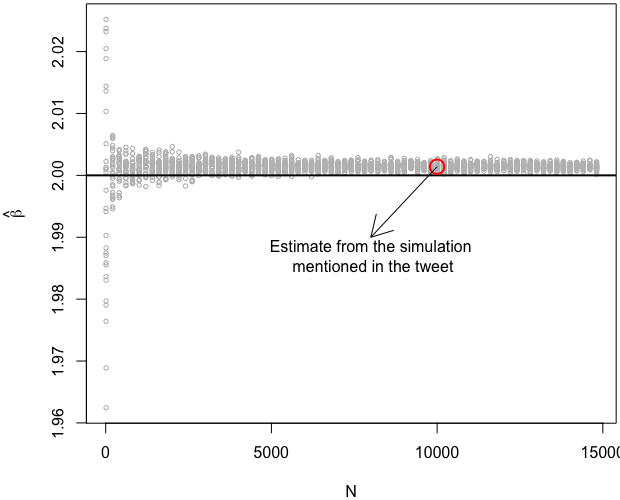
I have also marked the value 2.0014 in the plot corresponding to the sample size 10,000.
Does it really converge to the true parameter value?
At the first glance, the estimator appears to be converging indeed. However, after I marked the true parameter value (again, 2) with a horizontal line in the plot, it seems that it is converging to a value slightly higher than 2.
I have to remind myself often that seeing is not believing. Instead, seeing
can be a good start of thinking. Why does not the estimator appear to converge
to 2? I do not know. I do not even know if I’m talking nonsense in this post (so
now you know that I’m no longer qualified to be called Dr.
Xie). My intuition is that
$y \approx 2x + a\sqrt{x} + c$, where $a$ is a small constant. I will
appreciate it if anyone could give a rigorous explanation.
- Update on 2021-06-10
-
Nick has given an explanation, which is quite obvious in hindsight.
Xandeare actually correlated in the above simulation, becauseXcontains a linear terme, i.e., forX = e + 100e^2 + Z,e^2andZare not correlated withe, buteitself is certainly correlated withe. The correct simulation should be done without the linear term inX(or useabs(e), which is also not correlated withe):beta_est = function(N = 10) { e = runif(N) x = 100 * (e - .5)^2 + rnorm(N) y = 2 * x + e res = lm.fit(cbind(1, x), y) res$coefficients[2] # the slope }
Donate
As a freelancer (currently working as a contractor) and a dad of three kids, I truly appreciate your donation to support my writing and open-source software development! Your contribution helps me cope with financial uncertainty better, so I can spend more time on producing high-quality content and software. You can make a donation through methods below.
-
Venmo:
@yihui_xie, or Zelle:xie@yihui.name -
Paypal
-
If you have a Paypal account, you can follow the link https://paypal.me/YihuiXie or find me on Paypal via my email
xie@yihui.name. Please choose the payment type as “Family and Friends” (instead of “Goods and Services”) to avoid extra fees. -
If you don’t have Paypal, you may donate through this link via your debit or credit card. Paypal will charge a fee on my side.
-
-
Other ways:
WeChat Pay (微信支付:谢益辉) Alipay (支付宝:谢益辉) 

When sending money, please be sure to add a note “gift” or “donation” if possible, so it won’t be treated as my taxable income but a genuine gift. Needless to say, donation is completely voluntary and I appreciate any amount you can give.
Please feel free to email me if you prefer a different way to give. Thank you very much!
I’ll give back a significant portion of the donations to the open-source community and charities. For the record, I received about $30,000 in total (before tax) in 2024-25, and gave back about $15,000 (after tax).