NOTE: There’s a typo in the graph! The
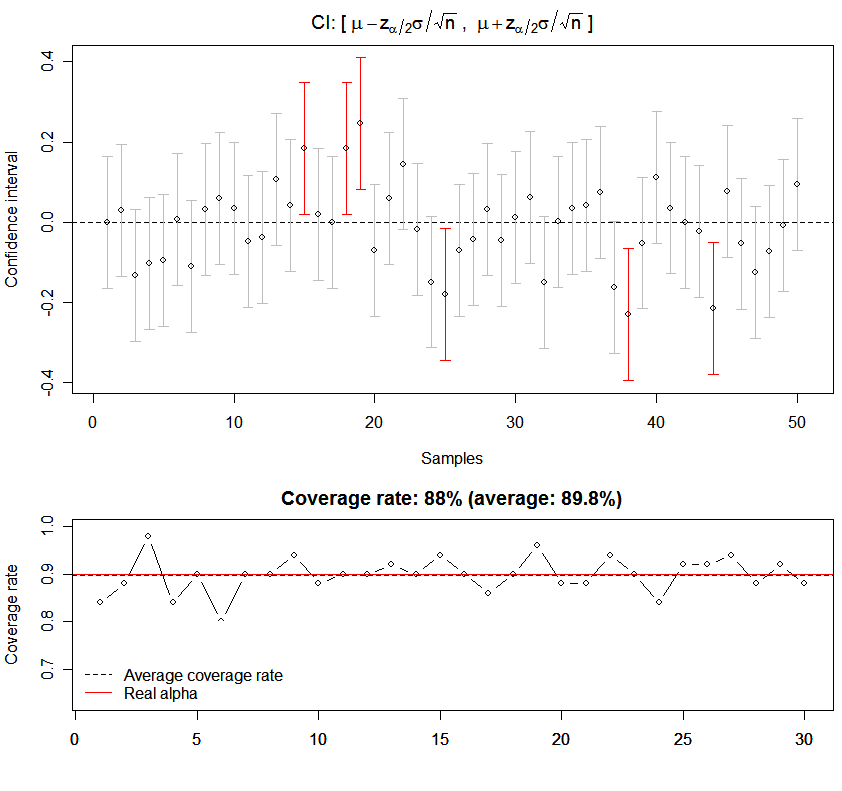
\(\mu\)should be replaced with the sample mean\(\bar{X}\)! And the code is available in the R package animation; seelibrary(animation); ?conf.int
Recently I’ve been thinking about attending the conference of IASC2008, and my vague idea is to use animations in statistical education, especially in the demonstration of some algorithms containing iterations or loops. Perhaps the main difficulty just lies in an integrated theory – currently I’m still not clear about the literature in this area (if anyone knows, please do drop me a line).
The other day when I was browsing the R documentation pages, I noticed that the amount of materials in those pages is increasing at a high speed. Among them I also saw some excellent web sites built by students (e.g. from Taiwan), which has triggered my own idea on building an independent website introducing animated pictures in statistics.
So… Let’s come back to the topic. In fact this is a demonstration I made several weeks ago, and today I modified it a little bit in order that the coverage rate can be better shown. The idea behind this simulation is simple: draw samples (random numbers) from the population which follows N(0, 1), and calculate confidence intervals (CI) based on these samples respectively. I believe everybody surely knows the formula in the main title of the figure below (suppose sigma is known, then compute the CI for the unknown mu).
R code for the demo:
library(animation)
conf.int
Donate
As a freelancer (currently working as a contractor) and a dad of three kids, I truly appreciate your donation to support my writing and open-source software development! Your contribution helps me cope with financial uncertainty better, so I can spend more time on producing high-quality content and software. You can make a donation through methods below.
-
Venmo:
@yihui_xie, or Zelle:xie@yihui.name -
Paypal
-
If you have a Paypal account, you can follow the link https://paypal.me/YihuiXie or find me on Paypal via my email
xie@yihui.name. Please choose the payment type as “Family and Friends” (instead of “Goods and Services”) to avoid extra fees. -
If you don’t have Paypal, you may donate through this link via your debit or credit card. Paypal will charge a fee on my side.
-
-
Other ways:
WeChat Pay (微信支付:谢益辉) Alipay (支付宝:谢益辉) 

When sending money, please be sure to add a note “gift” or “donation” if possible, so it won’t be treated as my taxable income but a genuine gift. Needless to say, donation is completely voluntary and I appreciate any amount you can give.
Please feel free to email me if you prefer a different way to give. Thank you very much!
I’ll give back a significant portion of the donations to the open-source community and charities. For the record, I received about $30,000 in total (before tax) in 2024-25, and gave back about $15,000 (after tax).